ENVIRONMENTS AND ORGANIZATIONS UNIVERSITY OF INNSBRUCK, INSTITUTE OF DESIGN, STUDIO1 WINTER 1011 GRADUATE PROGRAMM WITH STEFANO DE MARTINO, ALEX PFANZELT. HTTP://WWW.UIBK.AC.AT/GESTALTUNG/STUDIO1/
Tuesday, November 23, 2010
Black holes
We developed a method to investigate the airport as an acceleration force of time. The method was illustrated on the basis of Germanys international airport system.
true experience
this is the territory we act...
like a cognitive map we set the landmarks, we are travellers in this territory, we regcognize the accomodation and 3 sights...
we go by bus...we experience the route, we get the hole impressions of this way and so a much more detailed picture...
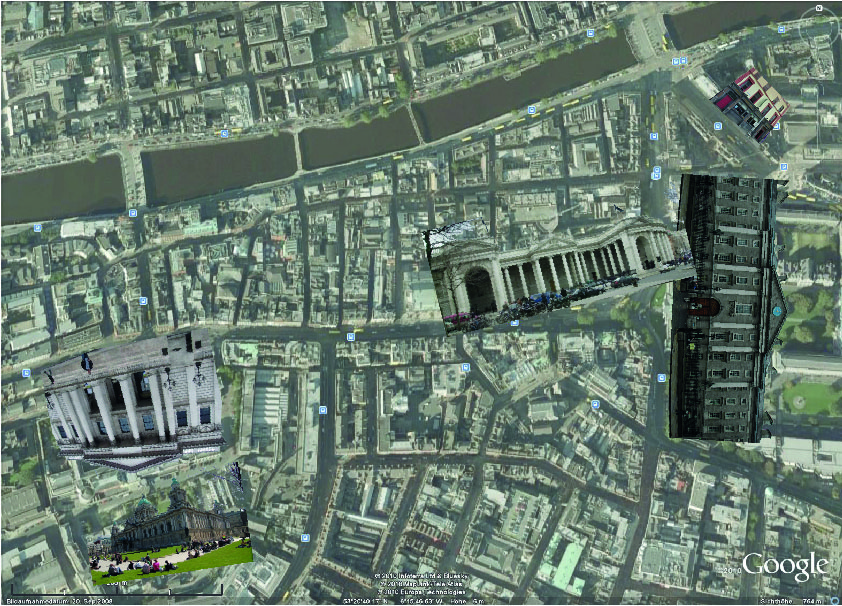
with google earth for example you are able to explore all this information...
in our case the most intesive and impressive experience could be that...
Monday, November 22, 2010
a city without architecture
No Stop City
archizoom
«No-Stop City» (1969) is an ironic critique of the ideology of architectural modernism taking onto its absurd limits: «The real revolution in radical architecture is the revolution of kitsch: mass cultural consumption, pop art, an industrial-commercial language. There is the idea of radicalizing the industrial component of modern architecture to the extreme.»
(Andrea Branzi)
«A city without architecture, therefore, where the urban landscape (cityscape) was formed by large anonymous containers, mechandise, industrial products, the plankton of data and the market.»
(Andrea Branzi)
«(...) the modern seen as a way of freeing people from culture and not as an opportunity to formulate a different culture. The various forms of an absolute secularism, and the downfall of al manner of qualitative utopia, thus making way for the only possible utopia of quantity, represented a liberating aspect (...)"
Andrea Branzi)
No Stop City is leading directly to projects of Archigram and Funpalace of Cedric Price.
Goolge Research Center - Zürich
The research center of google could be a possible interpretation of nowadays No-Stop City.
http://www.youtube.com/watch?v=TPz1Mou-Xxk&feature=player_embedded
Data Centers
Traces of the virtual world...
http://www.datacenterknowledge.com/
archizoom
«No-Stop City» (1969) is an ironic critique of the ideology of architectural modernism taking onto its absurd limits: «The real revolution in radical architecture is the revolution of kitsch: mass cultural consumption, pop art, an industrial-commercial language. There is the idea of radicalizing the industrial component of modern architecture to the extreme.»
(Andrea Branzi)
«A city without architecture, therefore, where the urban landscape (cityscape) was formed by large anonymous containers, mechandise, industrial products, the plankton of data and the market.»
(Andrea Branzi)
«(...) the modern seen as a way of freeing people from culture and not as an opportunity to formulate a different culture. The various forms of an absolute secularism, and the downfall of al manner of qualitative utopia, thus making way for the only possible utopia of quantity, represented a liberating aspect (...)" Andrea Branzi)
No Stop City is leading directly to projects of Archigram and Funpalace of Cedric Price.
Goolge Research Center - Zürich
The research center of google could be a possible interpretation of nowadays No-Stop City.
http://www.youtube.com/watch?v=TPz1Mou-Xxk&feature=player_embedded
Data Centers
Traces of the virtual world...http://www.datacenterknowledge.com/
the smooth and the striated game
"The war machine was perhaps the first thing to be striated. That is
where free action in smooth space must have been conquered."
(Gilles Deleuze and Felix Guattari)
Chess figures are coded. They have characteristic capacities which
determine their movements, positions and confrontations.
Go-stones are stones. Simple arithmetic units with collective, anonym
function which is caused by their surroundings. They are part of a larger
arrangement and have no determined but situational characteristics.
Therefore Go is the game of connections and constellations.
where free action in smooth space must have been conquered."
(Gilles Deleuze and Felix Guattari)
Flow becomes constant - without destination and direction.
It territorialises and deterritorialises space.
It is strategy.
Chess divides finite space.
Movement goes from point to point.
It codes and decodes space.
It is semiology.
It is semiology.
Chess figures are coded. They have characteristic capacities which
determine their movements, positions and confrontations.
Go-stones are stones. Simple arithmetic units with collective, anonym
function which is caused by their surroundings. They are part of a larger
arrangement and have no determined but situational characteristics.
Therefore Go is the game of connections and constellations.
Labels:
Münsch,
Stubenböck,
Wimmer
mops and hygrams
exploring the great hype machine

attempt to explain map and diagram relation with newtons theory of absolute and relative space
map >> absolute space, rhizomic, simultaneous, multible, dezentralized, neutral, outlines conditions
diagram >> relative space, relational space, developes from dependences, relations or forces between objects (gravitations), outlines processes
interesting from our point of view:
if a map can be seen as a neutral pool of quantitive information then what information do i choose?
'apparent' infinity as manipulation.
filtering out trends >> recognize parameters of change and displacement
relative space as instrument to measure absolute space vgl. diagram as tool to read maps
our topic for now:
exploring the great hype machine
IN-BETWEEN MAPS & DIAGRAMS Topic 2
IN-BETWEEN MAPS & DIAGRAMS Topic 1
the Wii-World
the landmarks and important buildings of their relativ cities are no longer fisical connected to them.
you can play every type of sport inside your 15-sqm-living-room; why you shouldn't be able to get the same feeling in the fields of sight-seeing, of traveling, of relaxing too?!
you are free to chose an adventurous safari in southern africa or a walk trough the hyde-park in australia. you aren't that affine to nature?! so you should try to sit comfortable in your sofa and thereby slide on max.speed trough the gallerys with the shinkansen-express! to fast?! enjoy a virtual meal in a buenos-aires-steakhouse or take a look in the caesars palace!!
you have your dreams on an arm-length!
on your tv-desk!!
you can play every type of sport inside your 15-sqm-living-room; why you shouldn't be able to get the same feeling in the fields of sight-seeing, of traveling, of relaxing too?!
you are free to chose an adventurous safari in southern africa or a walk trough the hyde-park in australia. you aren't that affine to nature?! so you should try to sit comfortable in your sofa and thereby slide on max.speed trough the gallerys with the shinkansen-express! to fast?! enjoy a virtual meal in a buenos-aires-steakhouse or take a look in the caesars palace!!
you have your dreams on an arm-length!
on your tv-desk!!
Thursday, November 18, 2010
HYPERREALITY
"Hyperreality: the simulation of something which actually never existed."
Jean Baudrillard
How technology changes our lifes?
We spend more and more time in new technologies, virtual plataforms... artificials spaces that transform the reality and allow us new possibilities that the real reality can't offer us.
Our lifestyle is based on saving the more time as possible, try to be as confortable as possible, get the staff as quick as possible...
Can we travel with this parameters?
Does virtual reality offer us the possibility of travelling without travelling? We mean; will it be possible to make virtual trips, helped by these new technologies?
Now we are capable to move in virtual worlds, to represent them in a Virtual space and experiment them.
But we really want to go further; if it was possible to "copy" for example, a city; so these virtual tourists could visit it, walk on all its streets, enter in its museums...the next step should be to be able to CREATE new cities, or mix existing city in order to create new virtual cities or spaces which could be visited in this way.
Imagine a world where all architects could create their buildings, their spaces, their "impossible projects" and everybody could be able to visit, understand, walk inside and experiment them.
Imagine having a city with no limits, in which you can settle your beloved idea, where you can show it to the world,...
A virtual city of exposition and exhibition, in constant change; in constant evolution....
Tuesday, November 16, 2010
Capturing Energy
We want to capture those unseen energies which occupy and influence the cities. (Movements, Light, Wind, emotional, . . .) We set up a time window in which we will analyze how those energies effect the cities. Depending on that our next step is to create storyboards for each energy. Overlapping this different Layers of energies allows a new visibility on cities which is shown in a compatible medium (collage, video,. . ).
value of the physical and the virtual
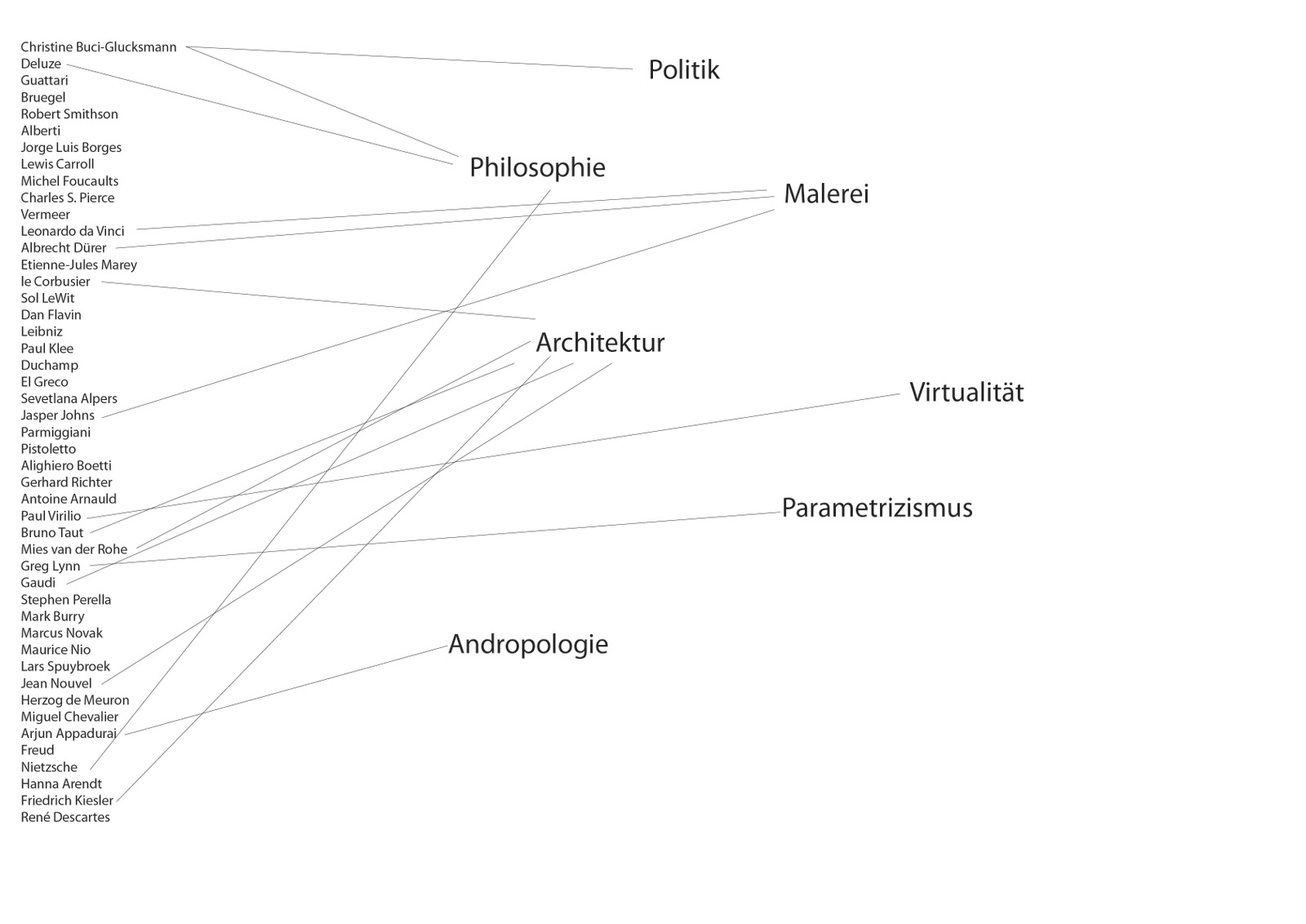
Based on Buci-Glucksmans analysation of the cartographic view we are focusing on how virtual modalities are now effecting physical realities.
As Buci-Glucksman mentioned in the text space gets transformed into time. A lot of works have been made (Greg Lynn, NOX...) which conceptualize and produce these virtual space-times that transform the real. Concerning these new topologies and surfaces another reality seems to be generated by the development of the cartographic view and the virtual. As mentioned in "A Networked Society" by Robert Sumrell, Kazys Varnelis phenomenons like the "One Wilshire" tower demonstrate the contradictionary relation of physical and virtual value. The physical value of this building is referenced only to it's importance for the virtual. This is also a product of the virtual space-time, a flat footed implementation of virtual and physical value.
interface of the city
Instruments
place, conection to other places, summery
movement between places
analyse about:
consume of alcohol
questionnair: time, alcohol, places,
insider as face of innsbruck- face modifide to interface
to invisible actions visible, actors make information clear and enlarge it
information are the parameter, which changes the design
analyse about:
consume of alcohol
questionnair: time, alcohol, places,
insider as face of innsbruck- face modifide to interface
to invisible actions visible, actors make information clear and enlarge it
information are the parameter, which changes the design
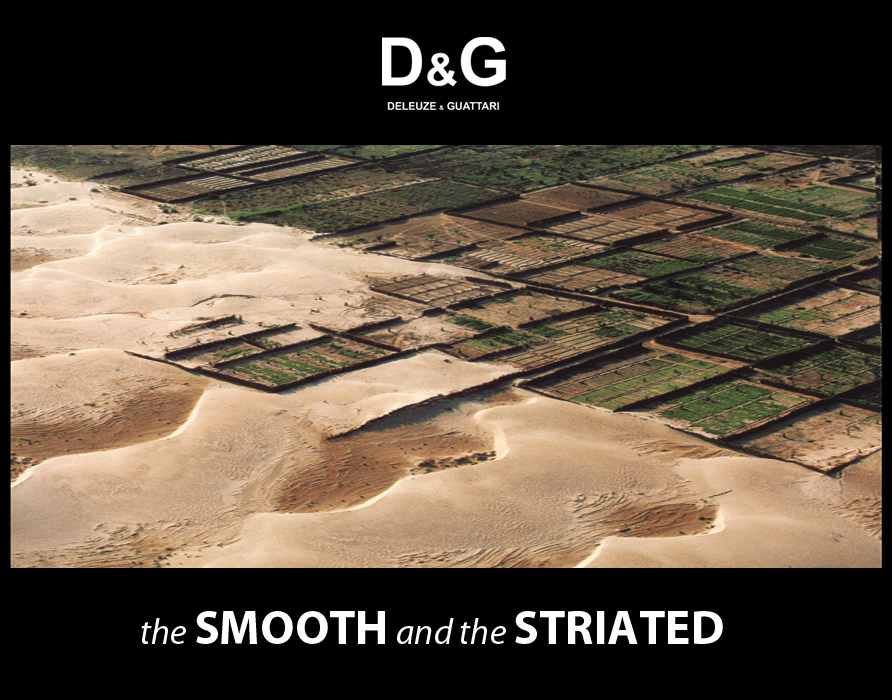
smooth / striated
The smooth and the striated space are fundamentally different. Sometimes the difference is simply the opposite of the other - sometimes the distinction is much more complex and while Deleuze and Guattari
consider these two spaces to differ in nature, they also believe that the two spaces in fact exist only in mixture.
In the simplest terms, Boulez says that in a smooth spacetime
one occupies without counting, whereas in a striated space-time one
counts in order to occupy.
The Sea and the City are the smooth and striated spaces par excellence.
Labels:
Münsch,
Stubenböck,
Wimmer
Virtual/Physical Culture Chasm
"To Think Is To Travel."
"... one needs to project oneself outside of oneself,
to forget one's own position, in order to explore
this cartography in rhizomes."
"The passage from a culture of stabilities and of objects,
with its Fordism and its industrial standards,
to a culture of instabilities and of flux
with its cyberspace and it's instantaneous communication,
gives rise to a new 'Folie du Voir' on a global scale."
"The map of the world is our interactive 'envelope',
in a world with neither protection nor envelope."
What is the gap between the virtual online world and the real physical world, in regards to of Web 2.0 and user-based input, in any one city?
To what extent do we think when we travel, in comparison to the days before iphones, trip advisor etc?
To what extent to we really explore, absorb and understand a city, when relying on, or are addicted to, new technologies such as urbanspoon, facebook places etc?
Labels:
Burns,
Dardaganis,
Keitel
trap streets
trap streets are errors purposely introduced into a map to catch copyright violators. If a competitor's map includes your "trap street"—a geographic feature that you've simply invented—then you (and your lawyers) will know they nicked your data, gave it a quick redesign and tried to pass it off as their own.
![]() |
| http://bldgblog.blogspot.com/2010/10/trap-rooms.html |
Labels:
Burns,
Dardaganis,
Keitel
the virtual transforms the real
…the map can also become a highly effective machine of power
(The Contemporary Cartorama – last paragraph)
…the real becomes more and more transformed by a virtual
(surfaces)
The map as a political instrument:
http://searchengineland.com/nicaragua-raids-costa-rica-blames-google-maps-54885
http://static02.mediaite.com/geekosystem/uploads/2010/11/NicarCosta.png
The World of Google:
Google languages and regions (according to the map of Theo Deutinger from 2007) differ strongly from the political map. Some countries are missing (mostly in Africa) and some exist in the world of google, but not on the Map of the U.N..
This map shows "wanna-be"-states of the world. Some of them are countries in the world of google.
source: http://td-architects.eu/
Labels:
Burns,
Dardaganis,
Keitel
Subscribe to:
Posts (Atom)